
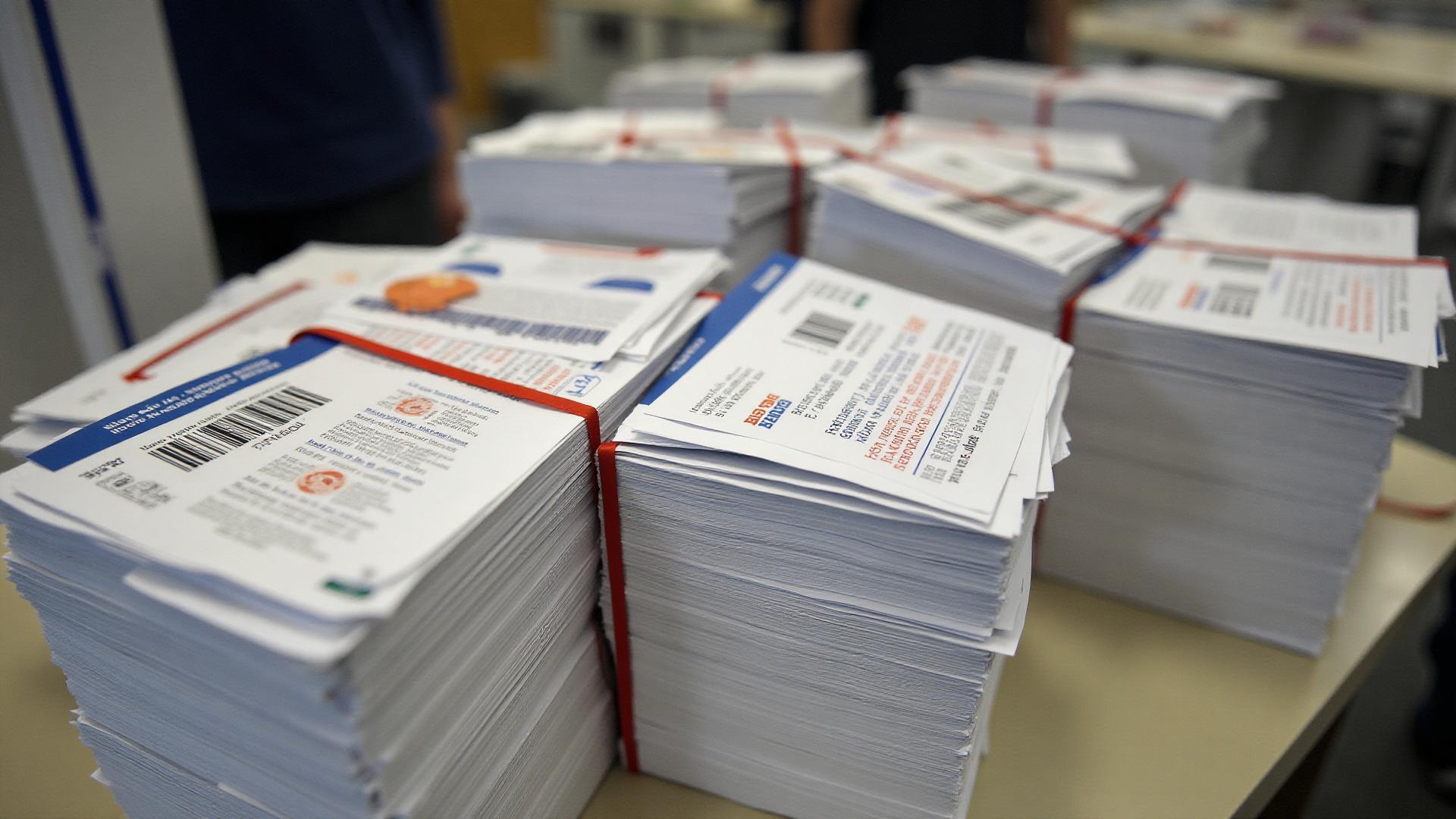
What is Bulk Mail?
Bulk mail refers to large quantities of mail pieces prepared according to specific USPS requirements that qualify for discounted postage rates. Rather than mailing individual pieces at retail postage rates, businesses can save 30-60% on postage by preparing mail in bulk according to USPS specifications.
The savings come from the work you do on behalf of USPS—sorting, organizing, and preparing mail in ways that reduce USPS processing costs. In exchange for this preparation work, USPS offers substantially reduced postage rates through their various bulk mail programs.
Bulk mail isn't a single service—it encompasses several USPS mail classes and programs, each with different requirements, costs, delivery speeds, and features. Understanding these options allows you to choose the most cost-effective approach for your specific direct mail campaigns.
Most businesses use either USPS Marketing Mail (formerly Standard Mail) or First-Class Mail presort for bulk mailings, with the choice depending on delivery speed requirements, forwarding needs, and budget constraints.

USPS Mail Classes for Direct Mail
USPS offers several mail classes suitable for direct mail marketing. Understanding the differences is critical for optimizing costs and campaign performance:
USPS Marketing Mail (Standard Mail)
USPS Marketing Mail is the most common and cost-effective class for bulk direct mail campaigns. Previously called Standard Mail, Marketing Mail offers the lowest postage rates available for advertising materials, promotional content, newsletters, and catalogs.
Minimum Requirements: Marketing Mail requires a minimum of 200 pieces or 50 pounds of mail per mailing. Pieces must be identical or nearly identical in content, sorted and bundled according to USPS specifications, and include proper USPS documentation and postage payment.
Current Rates: Marketing Mail postage typically ranges from $0.46 to $0.67 per piece for postcards and letters, depending on size, weight, and level of presort. Larger, heavier pieces and flats (oversized mail) cost more but still offer significant savings compared to First-Class rates.
Delivery Speed: Marketing Mail delivery takes 5-21 days, with most pieces arriving within 7-14 days. Delivery speed varies by destination, season, and USPS processing volumes. This slower delivery is the tradeoff for lower costs.
Forwarding and Return: Marketing Mail is not forwarded if recipients have moved, and undeliverable pieces are not returned unless you pay extra for address correction services. This means mailing list quality matters significantly—outdated addresses result in wasted impressions and costs.
Best For: Marketing Mail works best for time-flexible campaigns, large-volume mailings, promotional offers, brand awareness campaigns, and situations where lowest cost is the priority. Most direct mail marketers use Marketing Mail for the majority of their campaigns.
First-Class Mail (Presorted)
First-Class Mail is USPS's premium service, offering faster delivery, forwarding service, and return service. While more expensive than Marketing Mail, presorted First-Class Mail provides discounts when properly prepared in bulk.
Minimum Requirements: First-Class Mail presort requires a minimum of 500 pieces per mailing. Like Marketing Mail, pieces must be sorted and prepared according to USPS specifications to qualify for discounted rates.
Current Rates: Presorted First-Class Mail postcards cost approximately $0.48-$0.58 per piece (compared to $0.68 at retail rates), while presorted First-Class letters cost approximately $0.55-$0.68 per piece (compared to $0.73+ at retail). The exact discount depends on the level of presort and automation compatibility.
Delivery Speed: First-Class Mail typically delivers within 1-5 business days, significantly faster than Marketing Mail. This speed makes First-Class appropriate for time-sensitive campaigns where rapid delivery matters.
Forwarding and Return: First-Class Mail is automatically forwarded if recipients have filed change-of-address forms, and undeliverable pieces are returned to sender at no extra charge. This helps maintain mailing list accuracy and ensures your materials reach intended recipients even if they've moved.
Best For: First-Class presort works well for time-sensitive offers, high-value customer mailings, situations where list cleanliness is critical, campaigns targeting mobile populations (younger demographics move frequently), and when forwarding service justifies the higher cost.
Every Door Direct Mail (EDDM)
EDDM is a specialized bulk mail program that allows saturation mailing to entire carrier routes without purchasing or addressing mailing lists. EDDM offers the lowest postage rates available—currently $0.20-$0.22 per piece—because pieces don't require individual addressing or complex sorting.
Minimum Requirements: EDDM requires addressing at least 200 pieces per carrier route (though you can mail to multiple routes). Pieces must meet specific size requirements (minimum 6.25" x 11.5", maximum 15" x 12") and be bundled by carrier route.
Best For: Local businesses serving geographic areas, restaurants, retail stores, service providers, and any business where neighborhood saturation makes strategic sense. EDDM is covered in detail in our dedicated EDDM article.
Nonprofit Mail
Qualified nonprofit organizations can access even lower postage rates than commercial mailers. Nonprofit Standard Mail rates can be 40-50% lower than standard commercial rates, making direct mail extremely cost-effective for fundraising and donor communications.
Organizations must obtain nonprofit status from USPS (separate from IRS 501(c)(3) status) by submitting Form 3624. Once approved, nonprofits access substantially reduced postage for qualifying mailings related to their charitable missions.
Understanding Presort and Mail Preparation
Bulk mail discounts require proper mail preparation. Understanding presort requirements helps you maximize savings:
What is Presort?
Presort means organizing mail pieces by destination before presenting them to USPS. Rather than USPS sorting millions of random pieces by hand or machine, presorted mail arrives already grouped by ZIP code, carrier route, or delivery sequence—dramatically reducing USPS processing costs.
USPS offers different discount levels based on how thoroughly mail is presorted. The more work you do sorting and organizing, the deeper the postage discounts.
Presort Levels
5-Digit Presort: Mail sorted by 5-digit ZIP code (e.g., all pieces going to 03101 grouped together). This basic level earns moderate discounts and is the minimum for most bulk mail programs.
3-Digit Presort: Mail sorted by the first 3 digits of ZIP codes, grouping mail going to broader geographic areas. This deeper sort earns additional discounts.
Carrier Route Presort: Mail sorted by specific carrier routes—the most granular level, organizing mail by the exact paths mail carriers walk or drive each day. This maximum level of sorting earns the deepest discounts.
Professional mail houses use sophisticated software to analyze mailing lists, determine optimal presort strategies, and prepare mail to maximize discounts while meeting USPS requirements.
Automation Compatibility
Beyond presort, USPS offers additional discounts for mail pieces that can be processed by automated sorting equipment. This requires:
- Standard sizing that fits USPS automation equipment
- Proper address placement in automation-readable zones
- Barcodes (POSTNET, IMb, or Intelligent Mail barcodes)
- Address formatting that meets USPS addressing standards
Mail that meets automation requirements earns "automation rates"—typically 5-10 cents less per piece than non-automated rates. Professional direct mail providers ensure your mail meets automation standards to maximize these savings.
Address Quality and CASS Certification
USPS requires mailing lists to be CASS certified (Coding Accuracy Support System) within 180 days of mailing. CASS certification verifies that addresses are valid, properly formatted, and deliverable—ensuring mail reaches intended destinations and qualifies for automation discounts.
Professional direct mail services include CASS certification as part of their mail preparation, standardizing addresses, correcting errors, and removing undeliverable addresses before printing and mailing.
Comparing Mail Classes: Which Should You Choose?
Selecting the right mail class depends on your campaign objectives, budget, and timing requirements:
Choose Marketing Mail When:
- Lowest cost is your primary concern
- Your campaign isn't time-sensitive (offers valid for weeks/months)
- You're mailing large quantities (thousands of pieces)
- Your mailing list is clean and recently updated
- You're doing promotional mailings, awareness campaigns, or ongoing marketing
- Recipients don't need forwarding service
Choose First-Class Presort When:
- Time-sensitive offers require fast delivery (limited-time promotions, event invitations)
- Your target audience is mobile (younger demographics, urban areas)
- Forwarding service is valuable (ensures mail reaches recipients who've moved)
- You want undeliverable pieces returned to maintain list quality
- You're mailing high-value offers to qualified prospects
- Professional appearance and premium positioning matter
Choose EDDM When:
- Geographic saturation is your goal (reaching every household in specific areas)
- You want absolute lowest cost per piece ($0.20-$0.22 postage)
- You don't need demographic targeting beyond carrier route data
- You're a local business serving defined geographic territories
- You want simplified mail preparation without purchasing lists
Cost-Benefit Analysis
Consider a 5,000-piece postcard campaign to compare costs:
Marketing Mail: $0.50 postage + $0.25 print/prep = $0.75 per piece = $3,750 total. Delivery: 7-14 days. No forwarding.
First-Class Presort: $0.55 postage + $0.25 print/prep = $0.80 per piece = $4,000 total. Delivery: 1-5 days. Includes forwarding.
EDDM: $0.20 postage + $0.25 print/prep = $0.45 per piece = $2,250 total. Delivery: 7-14 days. No addressing required.
The $250 premium for First-Class over Marketing Mail might be worthwhile for time-sensitive campaigns, while EDDM's $1,500 savings makes it compelling when geographic saturation fits your strategy.
Maximizing Bulk Mail ROI
1. Optimize Mailing Quantities
Bulk mail pricing includes significant economies of scale. Per-piece costs drop dramatically as quantities increase. A 1,000-piece mailing might cost $1.00 per piece, while 10,000 pieces might drop to $0.65 per piece due to better printing rates and postage discounts.
If budget allows, larger quantities almost always deliver better ROI by reducing per-piece costs and reaching more prospects. Consider testing larger mailings to understand whether increased volume generates proportionally more revenue.
2. Invest in List Quality
Poor list quality wastes money on undeliverable mail. Invest in quality mailing lists from reputable providers, update lists regularly (NCOA - National Change of Address processing), remove duplicates and bad addresses, and suppress existing customers (unless intentionally targeting them).
Spending slightly more on quality lists dramatically improves deliverability and response rates, more than offsetting the additional list cost through better campaign performance.
3. Use Tracking and Analytics
USPS offers Informed Delivery tracking that shows when mail pieces are processed and delivered. Additionally, use campaign-specific tracking mechanisms:
- Unique phone numbers (call tracking to attribute leads to specific campaigns)
- Campaign-specific URLs and landing pages (track web traffic and conversions)
- Coupon codes (identify which campaigns drive purchases)
- QR codes with tracking parameters
Knowing which campaigns work allows you to optimize future mailings, double-down on successful strategies, and eliminate underperforming approaches.
4. Test Mail Classes
Don't assume one mail class always works best. Test Marketing Mail versus First-Class for specific campaigns to determine whether faster delivery justifies higher costs. Sometimes the speed advantage of First-Class generates enough additional response to deliver superior ROI despite higher per-piece costs.
5. Bundle Services for Better Pricing
Full-service direct mail providers often offer better pricing when you bundle design, printing, list acquisition, and mailing services. Rather than piecing together separate vendors, integrated solutions typically cost less while simplifying project management and ensuring seamless execution.
6. Plan Mailing Schedules Strategically
USPS processing times vary by season. The weeks before holidays see slower processing due to massive volumes. Plan time-sensitive campaigns with buffer room, or use First-Class Mail during peak seasons to ensure on-time delivery.
7. Leverage Commingling
Some mailing services offer commingling—combining your mail with other customers' mail to achieve better presort and deeper discounts. If your mailing volume doesn't meet carrier route presort minimums alone, commingling with other mailings can unlock lower rates.
Working with Bulk Mail Service Providers
While USPS allows businesses to prepare and submit bulk mail themselves, most companies achieve better results working with professional mailing houses and full-service direct mail providers. Here's why:
Expertise and Compliance
USPS bulk mail regulations are complex and change periodically. Professional providers stay current with requirements, ensuring your mail meets specifications and qualifies for maximum discounts. Mistakes in mail preparation can result in rejected mailings, delayed delivery, or loss of discounts.
Better Pricing
High-volume mailing houses negotiate better printing rates due to their purchasing power. They also achieve deeper postage discounts through advanced presort techniques and commingling services. These savings typically exceed the fees charged for their services.
Time Savings
Preparing bulk mail in-house requires staff time, specialized software, training, and postal visits. Outsourcing frees your team to focus on core business activities while experts handle technical mail preparation.
Integrated Services
Full-service providers handle every aspect: strategy consulting, list acquisition and management, professional design services, high-quality printing, mail preparation and presort, USPS documentation and delivery, tracking and reporting.
This integrated approach eliminates coordination hassles, ensures smooth execution, and typically delivers better results than managing multiple vendors separately.
What to Look for in Providers
When selecting a bulk mail service provider, consider: experience in your industry, transparent pricing with no hidden fees, USPS certification and compliance expertise, ability to handle your volume requirements, design and creative capabilities, list management services, tracking and reporting options, and customer service responsiveness.
Common Bulk Mail Mistakes to Avoid
1. Using Outdated Mailing Lists
Mailing to old lists wastes money on undeliverable addresses. Run NCOA (National Change of Address) processing and regularly clean lists to maintain deliverability above 95%.
2. Skipping CASS Certification
USPS requires CASS certification within 180 days of mailing. Non-certified lists don't qualify for automation discounts and may be rejected, costing you time and money.
3. Choosing Wrong Mail Class
Using First-Class when Marketing Mail would suffice wastes budget. Conversely, using Marketing Mail for time-sensitive offers may cause missed opportunities. Match mail class to campaign requirements.
4. Ignoring Size and Weight Restrictions
Exceeding maximum dimensions or weight limits triggers significantly higher postage rates. Design mail pieces that maximize impact while staying within rate thresholds.
5. Not Testing Variables
Mailing the same creative, offer, and list repeatedly without testing limits optimization opportunities. Test different approaches to continuously improve response rates and ROI.
6. Forgetting to Track Results
Without tracking, you can't measure success or optimize future campaigns. Implement tracking mechanisms from day one to understand what works and what doesn't.
Getting Started with Bulk Mail
Launching successful bulk mail campaigns requires understanding postage options, proper mail preparation, and strategic execution. While the technical details can seem overwhelming, partnering with experienced direct mail providers simplifies the process and ensures optimal results.
At IdentiReach, we specialize in full-service direct mail management including all aspects of bulk mail preparation, postage optimization, and campaign execution. Our team helps you select the right mail class for your objectives, prepare mail to maximize USPS discounts, ensure compliance with postal regulations, and deliver campaigns on time and on budget.
We work with businesses across industries—from local service providers to national retailers—to execute bulk mail campaigns that generate measurable ROI. Our transparent pricing includes all costs (no surprises), and we're committed to helping you achieve the best possible results from your direct mail investments.
Ready to launch your bulk mail campaign and take advantage of USPS postage discounts? Contact us for a free consultation and custom quote. We'll help you develop a strategy that maximizes your marketing budget and drives real business growth.